Large language models are impressive, but they have a fundamental constraint: they only know what was in their training data, frozen at a point in time. Ask GPT-4 about something that happened last week, or about your company’s internal docs, and it either hallucinates or admits ignorance.
Retrieval-Augmented Generation — RAG — is the standard solution.
The core idea
RAG is two steps:
- Retrieve relevant documents for the user’s query
- Generate a response using those documents as context
Instead of relying on what the model memorized during training, you hand it fresh information at inference time. The model becomes a reasoning engine over your data, not a knowledge store.
Step 1: Indexing
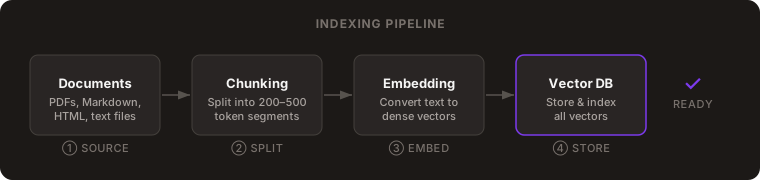
Before you can retrieve anything, you need to index your documents. This happens offline.
Each document (or chunk of a document) gets converted into a vector — a list of numbers that encodes its semantic meaning. This is done by an embedding model, a neural net trained to map text into a high-dimensional space where similar meanings land close together.
"The cat sat on the mat."  →  [0.12, -0.84, 0.33, ...]
"A feline rested on a rug." →  [0.11, -0.81, 0.35, ...]  # close!
"Quarterly revenue is up."  →  [0.92,  0.14, -0.67, ...]  # far
You store these vectors in a vector database — Pinecone, Weaviate, pgvector, Chroma, and others. The database is optimized for one operation: finding the N vectors closest to a query vector.
Step 2: Retrieval
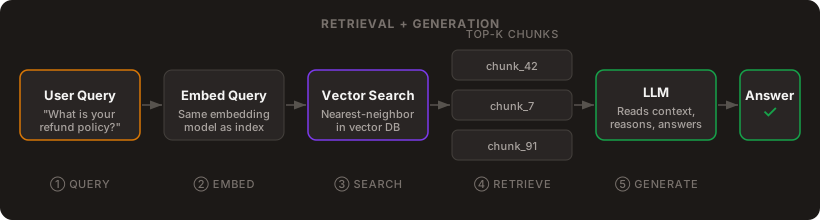
When a user asks a question, you embed their query using the same embedding model, then run a nearest-neighbor search against your vector database.
query: "what is our refund policy?"
  → embed query → [0.43, -0.21, ...]
  → search vector DB → top 3 matching chunks
  → return: [chunk_42, chunk_7, chunk_91]
The chunks that come back are semantically similar to the question — they might not share a single keyword, but they’re conceptually related.
Step 3: Generation
Now you build a prompt that includes both the user’s question and the retrieved chunks, and send it to the LLM:
System: You are a helpful assistant. Answer based only on the context below.

Context:
[chunk_42] Our refund policy allows returns within 30 days...
[chunk_7]  Refunds are processed within 5-7 business days...
[chunk_91] Digital products are non-refundable unless...

User: What is your refund policy?
The model reads the context and generates a grounded answer. If the context doesn’t contain the answer, a well-prompted model should say so rather than invent one.
Why it works
The key insight is that LLMs are exceptional at reading comprehension and synthesis. Give them a passage and a question, and they’ll extract and reason over the answer reliably. RAG exploits this — instead of asking the model to remember, you ask it to read.
This sidesteps the hallucination problem for factual questions: the model is constrained to what you gave it.
The moving parts
A production RAG system has a few components worth knowing:
Chunking strategy: You split documents into chunks before embedding. Too large and the chunk adds noise; too small and you lose context. Typical chunks are 200–500 tokens, sometimes with overlap so context doesn’t get cut at boundaries.
Embedding model: Separate from the LLM. OpenAI’s text-embedding-3-small, Cohere’s embed-v3, or open models like bge-m3 are common choices. The embedding model determines retrieval quality.
Retrieval depth (top-k): How many chunks to retrieve. More context = more coverage but longer prompts and more noise. 3–5 is a common default.
Reranking: A lightweight model that reorders retrieved chunks by relevance before they go into the prompt. Catches cases where vector similarity diverges from actual usefulness.
What RAG doesn’t solve
RAG is not a silver bullet.
If the right chunk isn’t in your index, retrieval fails silently — the model answers from a bad or empty context. Garbage in, garbage out.
Multi-hop questions are hard: “Who manages the team that owns the billing service?” requires connecting two facts that might live in different documents. Standard RAG retrieves one neighborhood; it doesn’t traverse graphs.
And RAG adds latency. Every query now involves an embedding call, a vector search, and a larger prompt.
RAG is fundamentally simple: look something up, then answer with it in hand. The complexity lives in the details — chunking, embedding quality, retrieval tuning, prompt design. But the architecture is just a smart use of the LLM’s best skill: reading.